SAIL TMT CRS and SAIL HCR: Your Complete Guide to High-Strength Rebars
When building the backbone of modern infrastructure—from skyscrapers to bridges—the quality of steel reinforcement bars (rebars) is non-negotiable. In India, two names stand out for reliability and performance: SAIL TMT CRS and SAIL HCR. But what exactly are they, and which one is right for your project? Let’s break it down in simple, practical terms.
SAIL TMT CRS: The Corrosion-Resistant Champion
SAIL TMT CRS stands for Steel Authority of India Limited Thermo-Mechanically Treated Corrosion Resistant Steel. That’s a technical mouthful, but think of it as a super-strong rebar with a built-in shield against rust.
Key Features & Benefits:
- Superior Corrosion Resistance: The special chemical composition (like added copper) forms a protective layer, dramatically slowing down rust. This is a game-changer for structures in coastal areas or with high exposure to moisture.
- Enhanced Durability: Less rust means a longer lifespan for the concrete structure, reducing maintenance costs over decades.
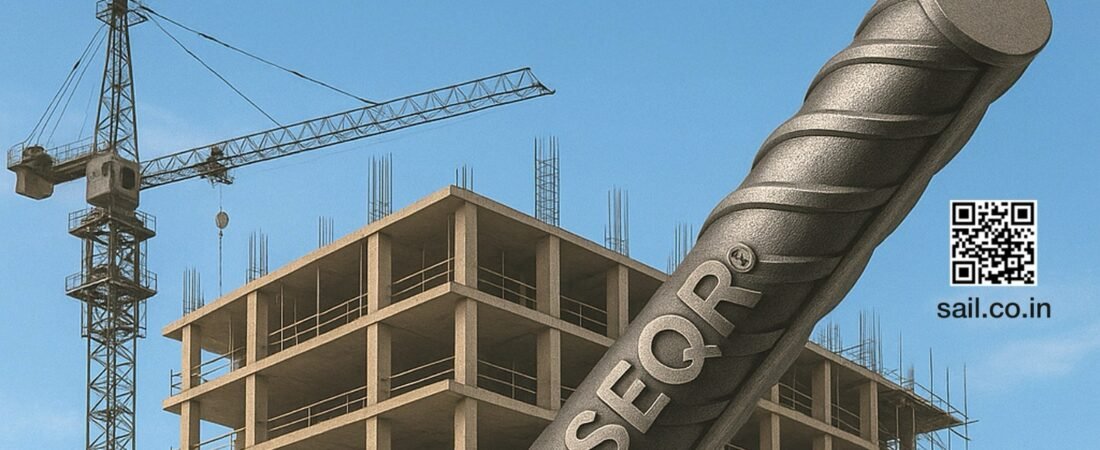
- Excellent Bond Strength: Its ribbed design grips concrete powerfully, ensuring the steel and concrete work together as one solid unit under stress.
- Earthquake Resistant: The perfect blend of strength and ductility (ability to bend without breaking) allows it to absorb seismic energy, making buildings safer.
Best For: Marine constructions, bridges, industrial structures, flyovers, and any project in high-humidity or corrosive environments where longevity is critical.
SAIL HCR: The High-Strength Workhorse
SAIL HCR means High Corrosion Resistance rebar. It’s another premium offering from SAIL designed to fight rust, but with a focus on delivering higher tensile strength.
Key Features & Benefits:
- Higher Tensile Strength: HCR rebars are engineered to bear heavier loads. This allows for the use of fewer bars in some designs, optimizing material cost and reducing congestion in concrete.
- Proven Corrosion Resistance: While both resist rust, HCR’s formulation is tailored for robust performance in aggressive environments, extending the service life of structures.
- Cost-Effective for Demanding Projects: The combination of high strength and corrosion resistance offers excellent value for large-scale infrastructure where both load-bearing capacity and durability are paramount.
- Weldability & Bendability: Despite its high strength, it maintains good workability on-site, allowing for fabrication as needed.
Best For: Heavy infrastructure like dams, power plants, high-rise buildings, long-span bridges, and strategic projects requiring a high strength-to-weight ratio.
SAIL TMT CRS vs. SAIL HCR: A Quick Comparison
| Feature | SAIL TMT CRS | SAIL HCR |
|---|---|---|
| Primary Focus | Exceptional corrosion resistance | High tensile strength + corrosion resistance |
| Ideal Application | Coastal, humid, corrosive environments | Heavy-load structures, large infrastructure |
| Key Advantage | Maximizes structure lifespan in tough conditions | Optimizes for strength and material efficiency |
| Trust Factor | Backed by SAIL’s stringent quality control and nationwide availability |
A Simple Analogy: Think of SAIL TMT CRS as a specialised all-weather coat—it’s your top choice when fighting relentless rain (corrosion). SAIL HCR is like a heavy-duty climbing jacket—built for tough conditions and carrying heavy loads, while still being weather-resistant.
Why Trust SAIL Rebars? The SAIL Assurance
Choosing SAIL isn’t just about picking a product; it’s about choosing peace of mind. Here’s why engineers and contractors nationwide trust SAIL:
- Experience & Legacy: SAIL is a Maharatna PSU with decades of experience in steelmaking, deeply intertwined with India’s growth story.
- Authority & Standards: Every bar complies with strict Indian Standards (IS 1786) and undergoes rigorous testing, ensuring what you get is exactly what the spec sheet promises.
- Trustworthiness: As a government-backed entity, SAIL’s commitment to quality and consistency is unwavering. The brand name on the bar is your guarantee.
- Nationwide Reach: Easy availability across India through a vast distributor network means your project stays on schedule.
Making the Right Choice for Your Project
Still unsure? Ask yourself these questions:
- Where is the structure located? (Coastal/Industrial area → lean towards TMT CRS)
- What is the primary load demand? (Extremely heavy loads → HCR is a strong candidate)
- What are the long-term maintenance goals? (Minimizing lifetime cost → both excel, with TMT CRS having an edge in highly corrosive settings).
Pro Tip: Always consult your structural engineer. They will perform the necessary calculations based on the specific site conditions and load requirements to specify the optimal grade—be it SAIL TMT CRS, SAIL HCR, or another variant.
Frequently Asked Questions (FAQs)
Q1: Is SAIL TMT CRS more expensive than regular TMT bars?
Yes, typically. The specialized alloying elements that boost corrosion resistance add to the cost. However, this initial investment is offset by significantly lower maintenance costs and a longer service life for the structure, making it a cost-effective choice in the long run.
Q2: Can SAIL HCR bars be welded on-site?
Yes, SAIL HCR bars have good weldability. However, it is crucial to follow proper welding procedures and use qualified welders to maintain the integrity of the steel’s properties. Always refer to the technical guidelines provided by SAIL.
Q3: How can I verify I am getting genuine SAIL TMT CRS or HCR bars?
Always purchase from authorized SAIL dealers or distributors. Genuine SAIL rebars have the SAIL logo, grade marking (e.g., CRS or HCR), and the IS 1786 mark clearly embossed on the bar. Ask for the Mill Test Certificate (MTC) for a batch, which is the quality assurance document from the steel plant.
Q4: Which is better for my house construction in a non-coastal city?
For standard residential buildings in non-coastal areas, SAIL’s regular TMT bars (like Fe 500 or Fe 550) are usually perfectly sufficient and cost-effective. Your engineer will recommend upgrading to CRS or HCR only if there are specific soil condition concerns (like high chlorides) or unusual design loads.
Q5: Does using HCR bars allow me to use less steel in my design?
Potentially, yes. Because HCR bars have higher tensile strength, a structural engineer might be able to design a slightly reduced rebar quantity for the same load. Never reduce steel on your own. The final design and quantity must always be as per the detailed structural drawing provided by your qualified engineer.
Q6: Where can I find technical specifications and weight charts?
The most reliable source is the official SAIL website (sail.co.in). You can also request detailed technical datasheets and guidance from your nearest authorized SAIL distributor.
Final Thought: Building is about creating legacies. Whether you choose SAIL TMT CRS for its relentless defence against the elements or SAIL HCR for its robust strength, you are laying down a foundation of trust. By partnering with a brand like SAIL and relying on the expertise of your engineering team, you’re not just constructing a building—you’re ensuring it stands safe and strong for generations to come.
Disclaimer: This article is for informational purposes. Product specifications and applications should always be verified with official SAIL publications and qualified civil/structural engineers.